
The Predictability Gap: Professionalizing the New Wave of US Aquaculture

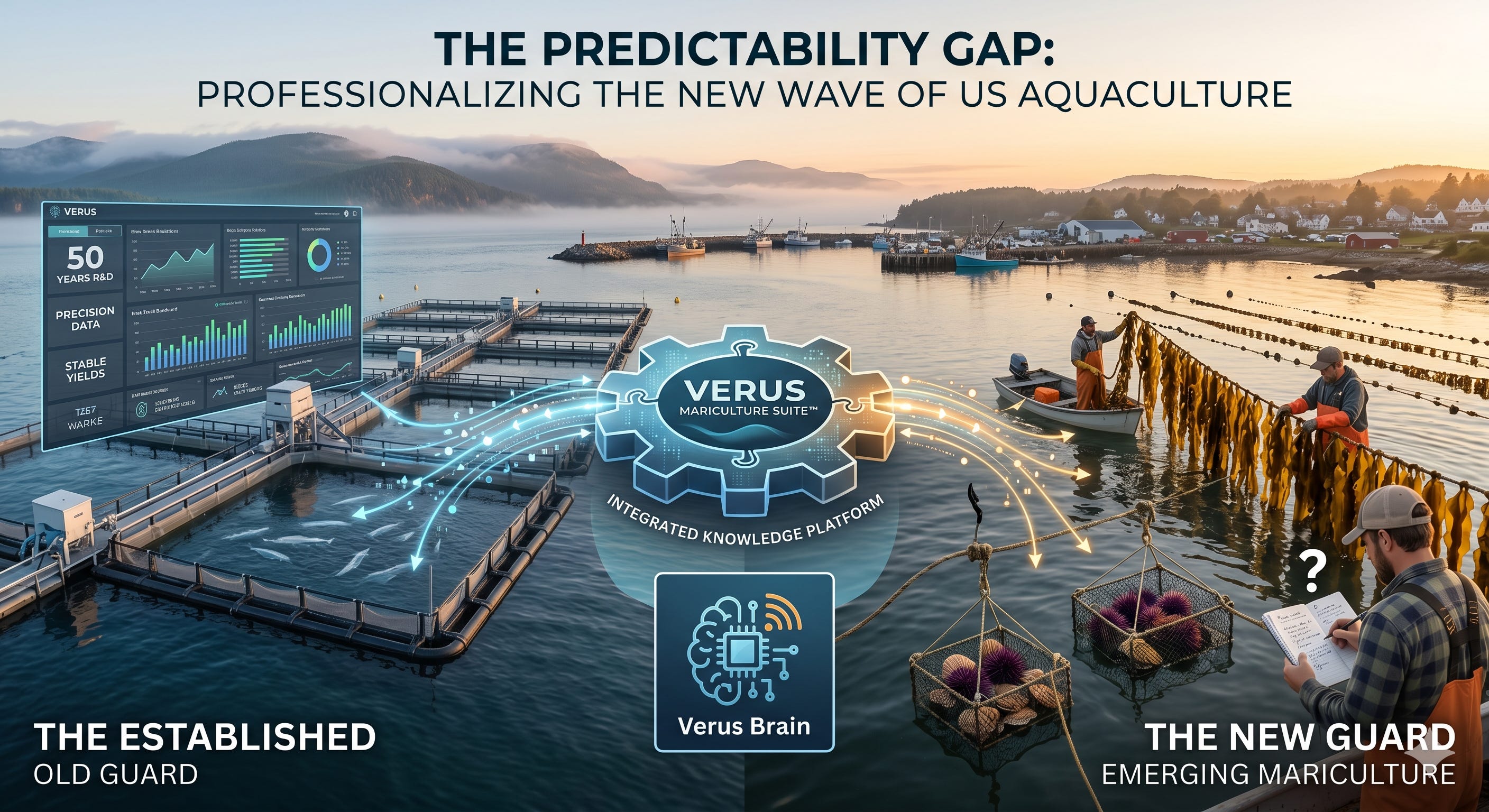
In the global world of aquaculture, Salmon and Shrimp are the gold standards—not necessarily because “big is better,” but because these industries have spent fifty years perfecting the science of predictability. They’ve turned biological volatility into a manageable process through decades of R&D, standardized protocols, and rigorous data analytics.
Meanwhile, along the US coastline, a vibrant “New Guard” is emerging. From Maine seaweed and Pacific oysters to boutique scallop and sea urchin ventures, the potential for high-quality, regenerative crops is massive.
However, there is a looming hurdle: The Knowledge Gap. While the enthusiasm for these new crops is high, many producers are entering the water with very little institutional memory to lean on. In the ocean, “learning the hard way” is often the most expensive way to fail.
The Maturity Wall: Industrial vs. Artisanal
The difference between a struggling farm and a successful one—regardless of its size—usually comes down to how much “invisible” data the farmer can see. The established players in the salmon, shrimp, and catfish sectors don’t just have more money; they have a more refined Operating System.
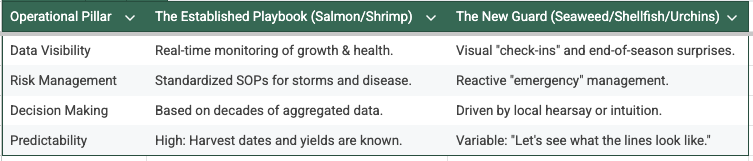
Most new entrants into mariculture are pioneers, often coming from outside the industry. They are tasked with mastering marine biology, mechanical engineering, and supply chain logistics simultaneously. Without a baseline of institutional knowledge, even a small-scale farm can become a financial sinkhole.
The Consolidation Trap: Data as a Shield
As the US mariculture sector grows, we are seeing a shift from a “wild west” of independent pioneers to a landscape of consolidation. When a small farm lacks the tools to prove its long-term viability or stabilize its yields, it often becomes a “distressed asset.”
We are already seeing this play out with the recent acquisition sprees of larger entities like Atlantic Aqua Farms. By rolling up smaller producers and independent processors, these larger players capitalize on their ability to centralize knowledge and capital.
For the small grower, the choice is increasingly stark: professionalize operations to remain competitive or eventually be absorbed. Consolidation often shifts power away from local communities. The primary reason small farms are vulnerable to these buyouts is that they lack the institutional knowledge to weather a bad season. Without a data-driven “brain” to optimize their farm, a single crop failure or a regulatory bottleneck can be a death knell, forcing a sale to a larger competitor that already has the infrastructure to absorb the hit, or as is often the case, closing shop.
Bridging the Gap: The Need for a “Biological Brain”
To move US mariculture from an artisanal experiment to a consistently successful industry, we need to bridge the gap between “working hard” and “working smart.” We need tools that act as a professional toolkit for the newcomer, providing the guardrails that prevent common (and costly) mistakes.
We are seeing the rise of Mariculture Support Systems designed to do exactly this. These aren’t just gadgets; they are systems that allow a first-year farmer to operate with the insight of a veteran.
One Path Forward: Integrated Suites
The Verus Mariculture Suite from Springtide Innovations is a prime example of this philosophy. It’s not just about selling a piece of gear; it’s about providing an integrated system that addresses the “missing” pieces of the puzzle:
The Verus “Brain”: An ERP (Enterprise Resource Planning) platform that allows a family-owned farm to track growth rates and harvest windows with the same precision as a multi-national while also providing an entry point into the supply chain.
Real-time Support with Snap & Send: Utilizing human centric-AI farmers have access to the most experienced aquaculture professionals and researchers available that are only a text message away.
Precision Farm Design: Moving beyond “good enough” site selection to data-driven farm layouts that maximize growth and minimize gear loss.
Specialized Hardware: Lightweight, species-specific tools (like urchin-specific cages) that recognize that a one-size-fits-all approach to gear leads to inefficiency.
While Verus is a leader in this space, the broader market is beginning to offer various data-driven tools—from Manolin’s health analytics to specialized shellfish tracking apps—all aimed at the same goal: replacing guesswork with evidence. The Verus difference is that is created by world leading farmers for farmers, not engineers and programmers who get their farm knowledge second hand.
Protecting the Waterfront
Successful aquaculture doesn’t have to mean massive, industrial-scale operations. It means farms that are ecologically sound and economically viable over the long term.
The transition from a collection of fragmented, high-risk leases to a stable industry requires a new layer of infrastructure. Not just physical ropes and buoys, but intellectual infrastructure. By adopting professional suites and standardized tools, independent producers can “skip the line” on the 20-year learning curve.
When we give farmers the tools to see what’s happening beneath the surface, we ensure that the next generation of US mariculture isn’t just a trend, but a permanent—and independent—success.